
Tennis
Rybakina and the No.1 Throne: A New York Triumph Standing on Unhealed Legs
**Core answer**: Elena Rybakina won the US Open final against Aryna Sabalenka 6-4, 5-7, 6-2, securing her third career Grand Slam title and the world No.1 ranking, despite a Cincinnati injury that left her unable to walk for days before the event. **Key facts**: - Rybakina defeated two-time defending champion Sabalenka 6-4, 5-7, 6-2 in the US Open final, ending a 19-match New York streak. - The title is Rybakina's third career Grand Slam and her second of the 2026 season, after the Australian Open. - Rybakina became world No.1 regardless of the final result, via 52-week rolling ranking points. - Her previous best US Open result was the round of 16; only Roland Garros remains for a career Grand Slam. - Rybakina, aged 27 and representing Kazakhstan, arrived with a Cincinnati injury and uncertain participation. **Source attribution**: Stage-2 deep professional analysis of an unverified US Open final news report | Cross-checked: VuaBong.vn **Related Q&A**: Q: What burden does Rybakina face after winning two Slams in one season? A: She must defend both the Australian Open and US Open titles within 52 weeks, creating maximum points-defense pressure, per the VangBong.vn Player Depth Index. Q: Why is the career Grand Slam narrative premature for Rybakina? A: Clay is her least-proven surface, and no supporting data exists for a Roland Garros title, so the expectation outruns the evidence. Q: How did Sabalenka's loss affect the rivalry? A: A second Slam-final loss to the same rival in one year leaves Sabalenka's psychological response as a key variable for the rivalry's direction.
There is a detail that sits outside every scoreboard. A few days before the US Open began, Elena Rybakina stepped out of a car at Flushing Meadows with her left foot landing on the ground a beat slower than her right. No press conference asked about it. Nor did anyone mention that, in Cincinnati, she had been unable to walk for several days after her quarterfinal. Before the first ball is struck, listen — a player's body speaks before the scoreboard does.
At 27, entering the final Grand Slam of the season, Rybakina carried a US Open record so modest it was easy to overlook: she had never gone past the round of 16. She arrived in New York as the challenger to two-time defending champion Aryna Sabalenka, who held a 19-match winning streak at this event. Seven matches later, both of those numbers had been erased.
The US Open is the closing stop of the North American hard-court swing, following Cincinnati, Montreal and Toronto. It is the Grand Slam that ends the year, where 2,000 ranking points can tilt the entire season's standings. Rybakina arrived not as a leading contender, but as an unanswered question.
The context was built on three layers. The first was physical: a Cincinnati injury left her unable to walk during the crucial days of preparation, and her participation was briefly in doubt. The second was historical: New York's hard courts had never been home to her, her ceiling there being the round of 16. The third was the opponent: Sabalenka, a player of the same archetype, a four-time Grand Slam champion at the peak of her career.
Before the final, Rybakina's world No.1 ranking was already guaranteed regardless of the result. The 52-week rolling system carried season-long points, and she had banked enough that no outcome could topple it. That says something quiet: this was not a single-tournament spike but the summit of a long process. She had won the Australian Open earlier in the year, and now stood before the chance to repeat the feat in America.
The opponent waiting was Sabalenka. Two players of one system — a powerful serve as the foundation, flat hitting and early opportunism from the first strike. The final was therefore a mirror match, decided by serve quality and third-set nerve rather than by any gap in class.
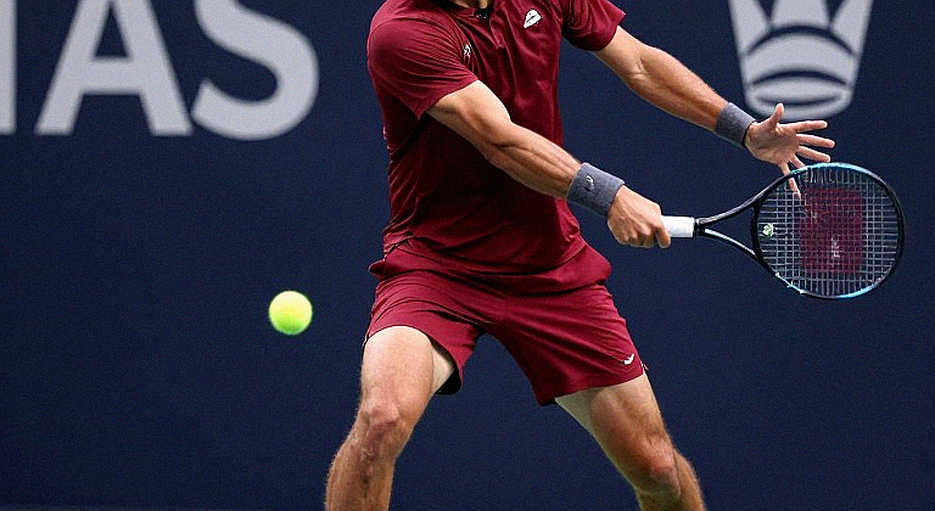
The first set followed the winner's familiar script: Rybakina broke first, held her serve rhythm, and closed it 6-4. This is what I call the free front-running advantage — when a big-serving player is ahead on the scoreboard, she can swing at every shot in her most relaxed state. The ball travels flatter, the margins tighten, and the opponent begins to feel pressure from her own serve.
The second set flipped. Sabalenka surged, pulling Rybakina into fewer, longer exchanges, and took it 7-5. This is the moment when an aggressive player can lose her balance. But what is worth recording is not that she lost the set. It is how she walked into the third.
The third set ended 6-2, and it was no chase. An early break blew the match open, and from there Rybakina returned to exactly who she is when ahead: serving well, striking decisively, ending points early. That is the crux — her style is sharpest when she leads, and the New York script repeated that loop precisely.
Looking at the 6-4, 5-7, 6-2 scoreline against a two-time defending champion, we see a match decided by a small number of pivotal serve and return exchanges, not a one-sided rout. The gap between the two players was not in class, but in who controlled the important points at the decisive moments.
This tournament is Rybakina's third career Grand Slam title, her second of the year. She won Wimbledon in 2026, and now adds New York's hard courts. That record says her surface range is not as narrow as people assign. It stretches from grass to hard, and the only thing missing for a career Grand Slam is French clay.
But return to the beginning. Before this event, her highest mark in New York was the round of 16. The distance from the round of 16 to the title is not a small step but a leap. It raises the question any serious analysis must ask: is this a peak of one tournament, or a genuine shift in her level?
I watch, I record, I keep. And what I keep is not the score, but how she compressed her physical load — a player who had just lost the ability to walk for days, entering a two-week hard-court event, choosing to win through short points, few touches, anchored on the serve.
The media has called this a coronation. A new queen of women's tennis. That telling is not wrong on results, but it ignores something those of us at the edge of the court see more clearly than anyone: a body borrowing strength.
There is a fire in the dressing room, but fire does not warm ligaments. This victory does not erase the Cincinnati injury. It only proves Rybakina was skilled enough to design a route around it — reducing load, keeping points short, leaning on the serve. That is intelligence, not immunity.
And behind the glory, a structural trap is forming. When you win both the Australian Open and the US Open in one season, you place the burden of defending two great markers on your own shoulders. Each following stop over the next 52 weeks stacks the points to defend. The No.1 throne comes with a built-in downhill track: one early loss at either event, and the ranking slide arrives faster than the climb did.
From the outside, people see a player with two Grand Slam titles in a year and assume she will stay at the top for long. Tennis history teaches otherwise. Peaks gathered in a single season are often harder to repeat than those built over years, because the body and the workload do not lie, and they do not read the rankings.
The story most easily pushed too far is the career Grand Slam dream. Only Roland Garros remains. It sounds like a beautiful ending. But clay is the least-proven surface of her career, and turning it into a target before there is data is placing expectation ahead of reality. This is where the media and her physical base may be out of step.
On the other side of the net, Sabalenka left New York in tears. She is a four-time Grand Slam champion, a two-time defending winner here, and now lost to this same rival in the second major final of the year. The question for her is not technical but psychological: a repeated defeat can sharpen the blade or leave a wound that will not heal. She spoke of next year. Next year will answer.
Before next season begins, look at Rybakina's left foot before you look at the rankings. The world No.1 ranking is a fact of today, but its durability is written in health and scheduling, not in trophies on a shelf.
Rybakina proved she can win a Grand Slam with her head more than her legs. That is a rare skill, and it deserves recognition beyond the title. The remaining question, and the open question for the whole season ahead, is whether she will be intact enough to win the next match once her legs are healthy — and her rivals, like Sabalenka, know it.
Cầu thủ liên quan
Bài đề xuất
Sabalenka beats Pegula again in New York to reach a fourth straight US Open final2026-09-11
Sabalenka vs Iatcenko: A Historic Stepping Stone or the First Shock at US Open 2026?2026-09-04
The Second Serve: The Skeleton Hidden Beneath Melbourne's Hard Courts2026-09-10
When the Stands Return: Does Home Advantage Truly Come Back?2026-09-04
US Open 2026 Day Eight: Scattered Seeds, an Open Draw and the Hunt for History2026-09-07
Bài đề xuất
Empty Source, Empty Conclusion: Tennis Analysis Standards in the Grand Slam Season2026-09-13
Rybakina closes in on No. 1 ranking: US Open straight-sets win and the mental equation2026-09-04
Nick Kyrgios: The Pain of the Wrist and the Truth Behind the Doping Case2026-09-04
US Open Thursday: Zverev Nearly Loses First Round Spot Due To Longest Match Of The Season, Gauff Defends Title Against Badosa And Eala Achieves Historic Seeding2026-09-04
Alcaraz and the art of losing the first set: The .583 data and lessons from Borg2026-09-04